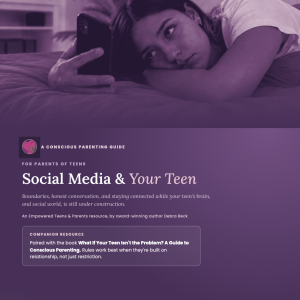


 How do you parent in this digital age?
Balancing Screen Rules, Understanding AI Use, and Staying Ahead of Social Media Changes
We’ve entered a digital era where technology evolves faster than parents can keep up and teens, who have never known life without it, often feel like they’re the experts.
When it comes to screen time, AI chatbots, and shifting social-media platforms, many families are feeling a widening disconnect.
If your teen has ever rolled their eyes at your “screen rules” or insisted “you just don’t get it,” you’re not alone. The goal isn’t to control your teen’s digital life, it’s to co-create healthy boundaries and understanding so that screens become a tool for connection, not conflict.
Here are three places we can improve our methods in this quickly changing world.
The first thing to look at is screen rules and collaboration.
- What to Do When Your Teen Rejects Your Screen Rules
Teens crave autonomy, and technology is one of the spaces where they can easily assert it. Unfortunately, that often turns into power struggles — you take the phone, they sneak it back; you set limits, they find a workaround.
Here’s how to shift the dynamic:
- Start with collaboration, not control. Ask your teen what they think healthy tech use looks like- you might be surprised by their insight.
- Share the “why.” Instead of enforcing arbitrary rules (“No phone after 9”), explain what screen time does to sleep, stress, and focus.
- Create mutual agreements. Treat screen boundaries like any other family agreement, revisited regularly as trust grows.
- Model balance. Teens will follow what you do, not what you say. As an example, keep your own devices out of reach during meals, car rides, or family time.
When you shift from a rule-giver to a partner in digital wellbeing, you show your teen that you trust them and that respect encourages responsibility.
Next, expand your own knowledge about AI.
- Understanding the New Wave of AI and Chatbot Use by Teens
AI isn’t just powering search engines anymore, it’s becoming a companion. Many teens are experimenting with AI chatbots to get homework help, vent about feelings, or explore identity safely. Regardless, while some of these tools can support creativity and mental-health reflection, they can also blur emotional boundaries and privacy lines.
What parents should know:
- AI isn’t neutral. Chatbots learn from the internet’s collective content — meaning they can repeat biases or misinformation.
- Emotional substitution is rising. Some teens use AI companions when they feel unseen or unsafe expressing emotions to real people.
- Privacy matters. Encourage your teen to avoid sharing personal details (names, locations, emotions, family issues) with AI tools.
Use curiosity, not fear. Ask: “What do you like about talking to that AI?” rather than “Why are you doing that?” you’ll learn more and keep the door open for dialogue.
Thirdly, as parents we need to stay aware of our kid’s social media use.
- Social Media’s Shift to “PG-13” — How Parents Can Stay Ahead Updates reported by The Verge
Instagram and other platforms are moving toward PG-13-style experiences — limiting mature content and introducing teen safety controls. However, while that’s encouraging, it doesn’t replace parental awareness.
To stay ahead:
- Review your teen’s app settings together. Many platforms now offer Family Centers where parents and teens can co-manage safety tools.
- Talk about why content is filtered — this builds media literacy, not censorship.
- Remember: the average teen is on multiple platforms (Instagram, TikTok, Discord, BeReal), consequently parental connection is more powerful than monitoring.
In short, staying current and parenting in this digital age doesn’t mean mastering every app, it means modeling curiosity, respect, and shared responsibility for online wellbeing. It’s hard for parents to stay ahead of the curve in this ever changing digital world. As parents we need to have great tools and know how to instill limits without pushing teens away.
For more help with this, check out my new Parenting Workshop, Family Retreats or Mentoring Programs.

In my book, What If Your Teen Isn’t the Problem? A Guide to Conscious Parenting, I talk about the importance of doing our own inner work. Parenting is less about controlling our kids and more about noticing our triggers and fears. When you pause and ask, “What’s really holding me back in parenting from a place of Love instead of Fear”, and explore what comes up for yourself, as a result you begin to shift the focus inward.
Book a Free Consult Here to see all of the options I provide for help in guiding your teen.
Warmly, Debra